Migraines are not just headaches.
They are neurological events that affect how your brain processes pain, light, sound, and even stress.
For many people, relief feels temporary. Medication helps, but the cycle often returns.
That is where yoga comes in.
Not as a replacement for medical care, but as a scientifically supported way to reduce frequency, intensity, and triggers of migraines.
What Happens During a Migraine?
Migraines involve complex neurological changes, including:
Activation of the trigeminovascular system
Increased sensitivity in pain pathways
Changes in brainstem activity
Triggers such as stress, poor sleep, and muscle tension
According to the World Health Organization, migraines are one of the leading causes of disability worldwide.
This means effective management requires more than just symptom relief. It requires regulation.
Can Yoga Help with Migraines? (What the Research Says)
Clinical research supports yoga as a complementary therapy.
A study published in JAMA Neurology found that people who practiced yoga alongside standard treatment experienced:
Fewer migraine days
Reduced pain intensity
Lower dependence on medication
Another review in Frontiers in Neurology highlights that yoga helps:
Regulate the autonomic nervous system
Lower cortisol levels
Improve blood flow and muscle relaxation
In simple terms, yoga helps the body stay out of a constant stress response.
Why Yoga Works for Migraine Relief
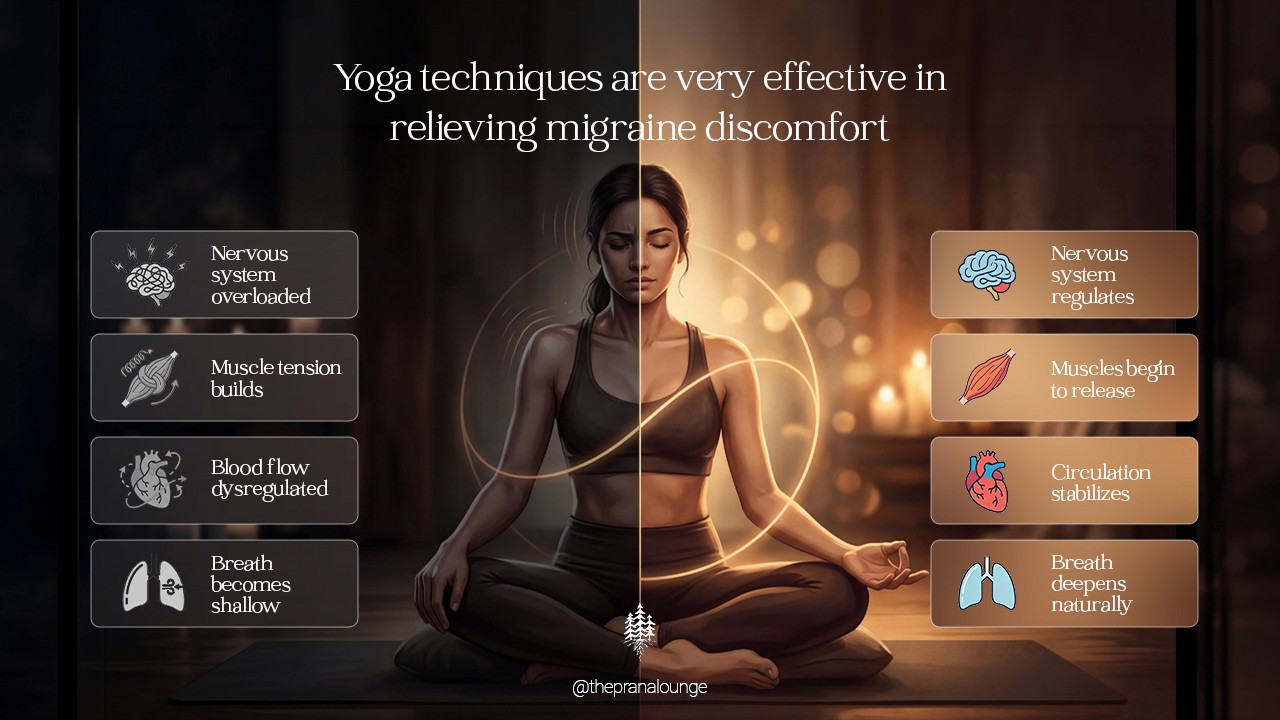
Yoga addresses three key migraine triggers:
1. Stress and Nervous System Imbalance
Breathing techniques activate the parasympathetic nervous system, reducing stress signals.
2. Muscle Tension
Gentle movement releases tightness in the neck, shoulders, and upper back.
3. Circulation and Oxygen Flow
Controlled breathing improves blood flow and stabilizes vascular function.
This combination makes yoga a powerful support tool for migraine management.
Effective Yoga Techniques for Migraine Relief
These techniques are simple, low-intensity, and suitable for regular practice.
1. Child’s Pose (Balasana)
Benefits:
Relieves neck and shoulder tension
Promotes relaxation
Reduces sensory overload
How to practice:
Knees apart, forehead resting down
Arms relaxed
Hold for 1 to 3 minutes
2. Alternate Nostril Breathing (Nadi Shodhana)
Benefits:
Reduces stress and anxiety
Balances brain activity
Supports nervous system stability
How to practice:
Inhale through one nostril
Exhale through the other
Continue for 5 to 10 minutes
3. Legs-Up-the-Wall (Viparita Karani)
Benefits:
Improves circulation
Reduces fatigue
Promotes deep relaxation
How to practice:
Lie down with legs against a wall
Stay for 5 to 10 minutes
4. Cat–Cow Movement
Benefits:
Releases spinal and neck tension
Improves circulation
Connects breath with movement
How to practice:
Inhale and arch the back
Exhale and round the spine
Repeat slowly for 1 to 2 minutes
5. Guided Relaxation (Yoga Nidra)
Benefits:
Reduces stress hormones
Improves sleep quality
Enhances pain tolerance
Even short sessions can support migraine relief.
Tips for Practicing Yoga with Migraines
To get the best results:
Practice in a quiet, low-light environment
Avoid intense movements during an active migraine
Stay hydrated
Be consistent with short, gentle sessions
Combine with medical care if needed
Migraines are complex, and there is no single solution.
But yoga offers something valuable.
It helps the body move out of stress and into balance.
Not instantly. Not dramatically.
But steadily.
Sometimes relief is not about doing more.
It is about allowing the body to do less.
And in that space, healing begins.
✨ Ready to reset? Book your class today.