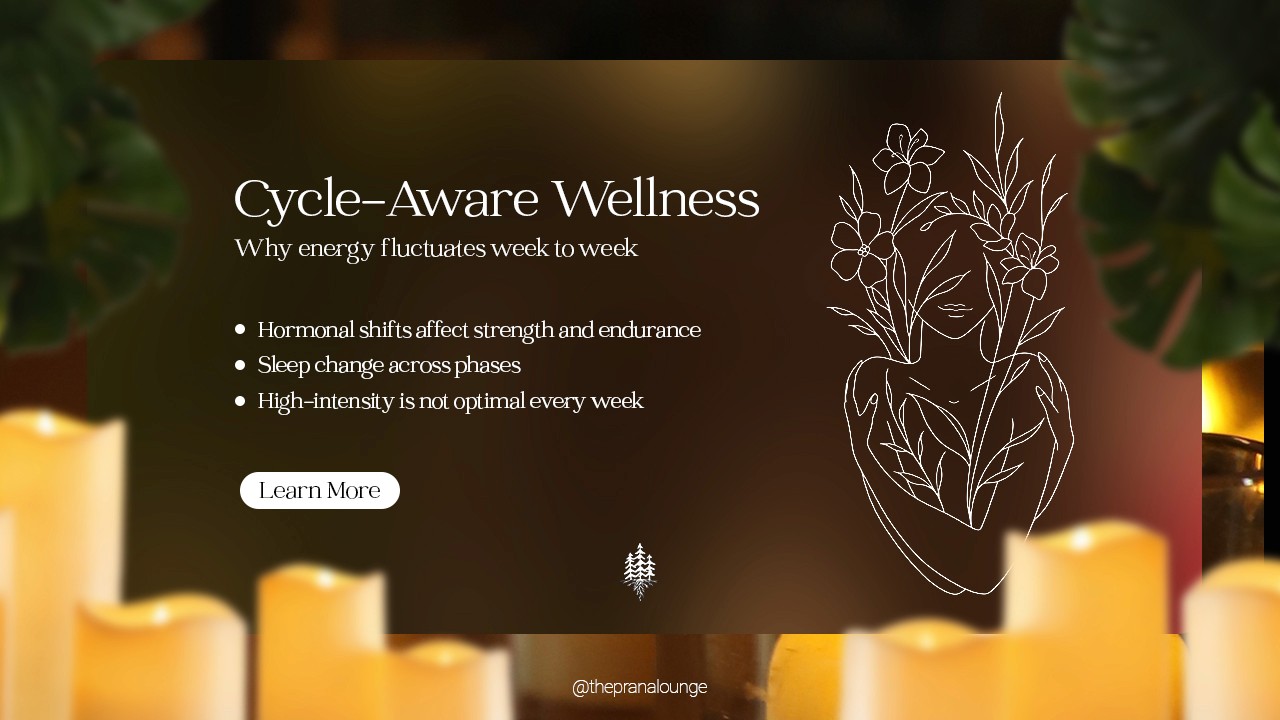
Energy is not meant to feel the same every week.
For women of reproductive age, hormonal fluctuations across the menstrual cycle influence mood, sleep, metabolism, and physical performance. Yet many training programs assume consistency means maintaining the same intensity daily.
Cycle-aware wellness takes a different approach. It recognizes that hormonal rhythms can affect how the body responds to stress, strength training, and recovery.
Understanding Energy Fluctuations Across the Menstrual Cycle
The menstrual cycle is typically divided into two main phases: the follicular phase and the luteal phase. Estrogen rises during the follicular phase and peaks before ovulation. Progesterone becomes more dominant during the luteal phase.
Research suggests that these hormonal shifts can influence exercise performance. Some studies indicate that women may experience improved strength and power output during the early to mid-follicular phase, when estrogen is rising and progesterone remains low. In contrast, the late luteal phase is often associated with increased fatigue, higher perceived exertion, and changes in thermoregulation.
It is important to note that responses vary between individuals. However, physiological fluctuations are real and measurable.
Energy variability is not an inconsistency. It is biology.
When Strength Training May Feel Most Supportive
Several research reviews have explored how menstrual cycle phases influence resistance training adaptation. While findings are not entirely uniform, some evidence suggests that women may respond well to higher-intensity strength training during the follicular phase.
Estrogen has been shown to play a role in muscle repair and protein synthesis. Lower progesterone levels during the early cycle may also support recovery. This may explain why some women report feeling stronger or more powerful during this phase.
This does not mean strength training should be avoided in other phases. It means that higher intensity sessions may feel more manageable or productive at certain times.
Listening to performance feedback can help guide programming.
When Recovery Work Becomes More Important
During the luteal phase, progesterone levels rise. Research has associated this phase with increased core temperature, potential sleep disturbance, and higher perceived effort during exercise. Some women also report premenstrual symptoms such as bloating, mood shifts, and fatigue.
In this phase, restorative practices such as mobility work, slower strength training, breath-led movement, or lower-intensity sessions may feel more supportive.
There is no evidence suggesting that women must reduce activity in the luteal phase. However, adjusting intensity based on energy levels may help reduce cumulative stress.
Regulation supports sustainability.
Redefining Consistency
Consistency is often interpreted as repeating the same intensity week after week. Cycle-aware wellness reframes consistency as commitment to movement, not identical output.
From a physiological perspective, adaptation occurs when stress is followed by recovery. Hormonal fluctuations can influence how that stress is experienced. Aligning training demands with internal rhythms may support long-term adherence and reduce frustration.
This approach is not about limiting women. It is about respecting biological variability.
Training with the body instead of against it acknowledges that strength is dynamic. Some weeks will feel powerful. Others may call for regulation.
Both are productive.
Cycle-aware wellness encourages observation rather than judgment. By tracking energy, sleep, and perceived effort across the cycle, patterns often become clearer.
Consistency does not require identical intensity.
It requires responsiveness.
When movement aligns with physiology, performance becomes more sustainable, recovery becomes more intentional, and overall wellbeing can feel more stable.
Moving with the cycle is not about doing less.
It is about training intelligently across phases.
✨ Ready to reset? Book your class today.