Jan 29, 2026
Three Ways to Wellness: How Physical, Mental, and Emotional Health Work Together
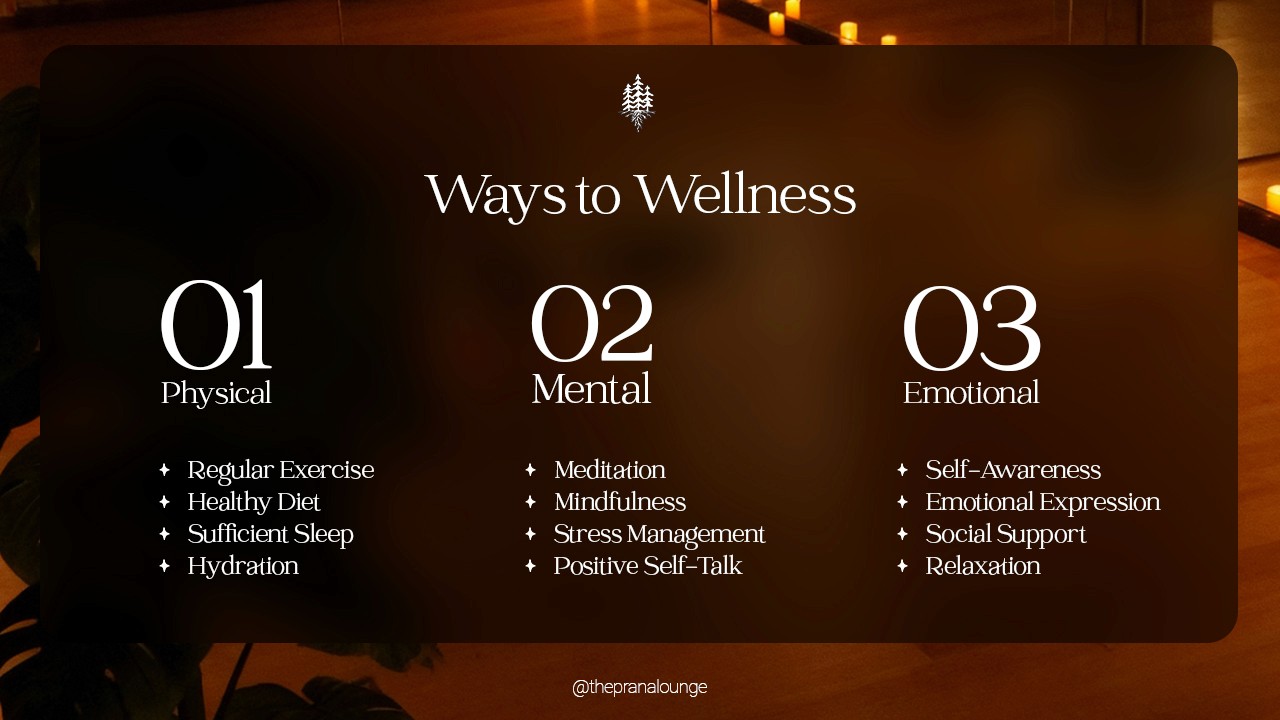
Wellness is often presented as a checklist. Eat better. Move more. Stress less.
But the human body does not operate in silos. It functions as an integrated system where physical states influence mental clarity, mental patterns shape emotional regulation, and emotional safety determines how the body heals.
Modern health science increasingly supports what holistic traditions have long suggested: lasting wellness emerges when physical, mental, and emotional health are addressed together. Not as separate goals, but as interdependent processes.
01. Physical Wellness: The Foundation of Biological Stability
Physical wellness is not about aesthetics or performance. It is about creating stable biological conditions so the body can regulate itself effectively.
Regular movement improves cardiovascular efficiency, insulin sensitivity, and mitochondrial function. According to The Journal of Physiology, moderate, consistent exercise enhances oxygen delivery and reduces systemic inflammation, both of which are foundational for energy and recovery.
Sleep plays an equally critical role. Research published in Nature Reviews Neuroscience shows that deep sleep supports synaptic pruning, hormonal regulation, and immune function. Chronic sleep deprivation, on the other hand, increases cortisol and impairs glucose metabolism.
Nutrition and hydration are often discussed in terms of calories and macros, but their primary function is cellular communication. Adequate hydration maintains blood volume and neural signaling. Balanced nutrition supports neurotransmitter synthesis and gut microbiome diversity, which directly affects mood and immunity, as outlined in Cell Metabolism.
Physical wellness creates the baseline. Without it, mental and emotional regulation become significantly harder to sustain.
02. Mental Wellness: Training the Brain’s Response Systems
Mental wellness is not the absence of thought. It is the ability to regulate attention, perception, and stress responses.
Meditation and mindfulness have been extensively studied in neuroscience. Functional MRI research from Harvard Medical School shows that regular mindfulness practice reduces activity in the default mode network, the brain circuit associated with rumination and mental fatigue. At the same time, regions involved in executive function and emotional regulation become more efficient.
Stress management is not about avoiding stress entirely. According to the American Psychological Association, stress becomes harmful when recovery is insufficient. Chronic activation of the stress response disrupts memory, sleep, digestion, and immune regulation.
Positive self-talk is not motivational fluff. Cognitive neuroscience research published in Frontiers in Psychology demonstrates that self-directed language influences emotional processing and threat perception in the brain. How we speak to ourselves alters neural activation patterns, directly affecting stress hormones and decision-making.
Mental wellness gives the nervous system context. It helps the brain decide whether the body is safe enough to rest, digest, and repair.
03. Emotional Wellness: The Regulator of Safety and Connection
Emotional wellness is often misunderstood as emotional control. In reality, it is emotional awareness and expression.
Self-awareness allows the brain to label emotional states. Studies in Psychological Science show that naming emotions reduces amygdala activity and increases prefrontal regulation. When emotions are acknowledged, physiological stress responses diminish.
Emotional expression plays a critical role in nervous system health. Suppressed emotions are associated with elevated sympathetic activation and increased inflammatory markers, according to research in Psychosomatic Medicine.
Social support is one of the strongest predictors of long-term health outcomes. Large-scale studies published in The Lancet demonstrate that social connection lowers mortality risk, improves immune function, and reduces stress-related disease. Human nervous systems are wired for co-regulation.
Relaxation is not passive. Techniques that promote relaxation activate the parasympathetic nervous system, improving heart rate variability and hormonal balance. This physiological shift supports emotional resilience and recovery.
Emotional wellness signals safety. Without safety, healing does not occur.
Why These Three Cannot Be Separated
Physical, mental, and emotional wellness are not independent categories. They are feedback loops.
Poor sleep increases emotional reactivity. Chronic stress disrupts digestion and immunity. Emotional suppression elevates cortisol and muscle tension. The body listens to the mind. The mind listens to the body. The nervous system listens to both.
This is why integrated practices work.
At Prana, wellness is approached through this lens. Movement supports circulation and nervous system signaling. Breathwork regulates stress responses. Stillness trains attention. Warmth encourages tissue relaxation and recovery. Community provides emotional safety.
Each practice speaks to a different entry point. All of them converge in the nervous system.
Wellness Is a State, Not a Performance
True wellness is not achieved by doing more. It emerges when the body receives consistent signals of support.
Physical care stabilizes biology.
Mental practices shape perception.
Emotional safety enables repair.
When these align, the body does what it is designed to do: heal, adapt, and sustain energy.
Wellness is not something you chase.
It is something you allow.
✨ Ready to reset? Book your class today.