Well-being is often treated as a trend. A supplement. A routine to optimize.
But in biology, well-being is far more practical. It is the body’s ability to maintain balance under stress and return to regulation after disruption.
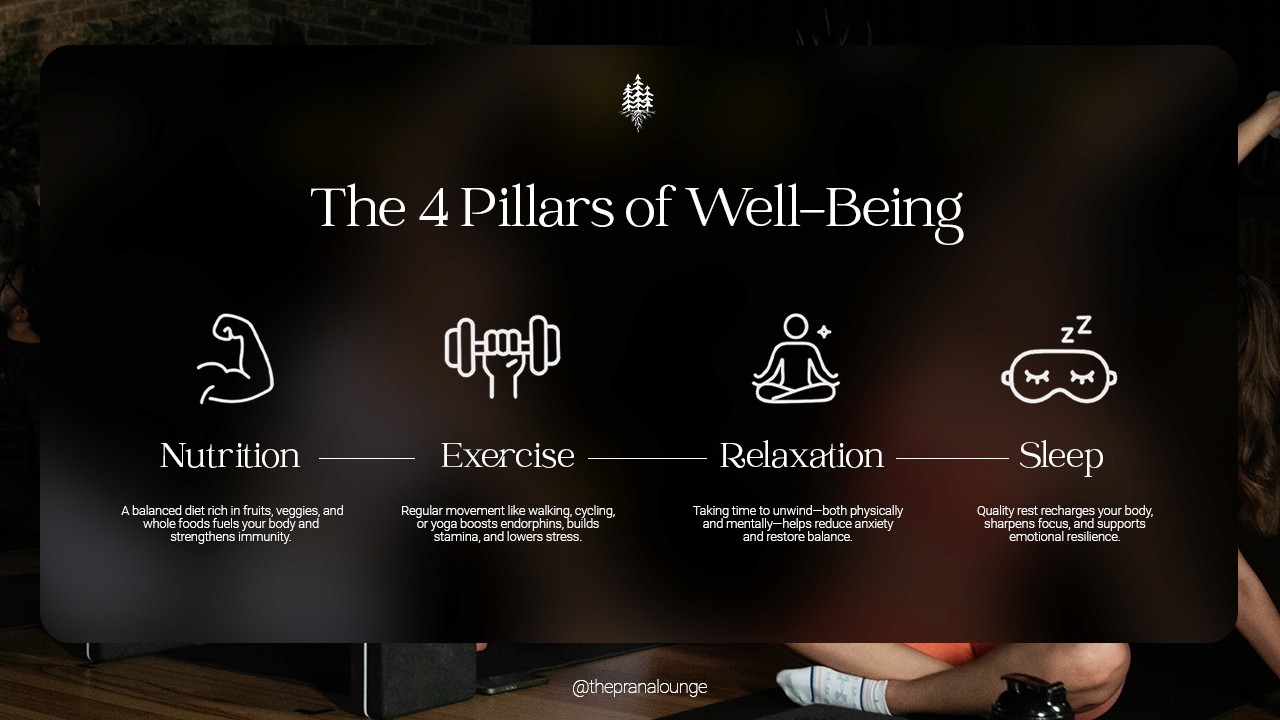
Modern health science consistently points to four non-negotiables that support this balance: nutrition, movement, relaxation, and sleep. Not as lifestyle upgrades, but as core physiological requirements.
When one pillar weakens, the system compensates. When several weaken, recovery slows. And when all four are supported, the body does what it has always known how to do.
Heal.
1. Nutrition: Information, Not Just Fuel
Food is often framed as energy. In reality, it is information.
Nutrients act as biochemical signals that regulate inflammation, immune response, neurotransmitter production, and cellular repair. A diet rich in whole foods, fiber, and micronutrients supports metabolic stability and gut microbiome diversity, which in turn influences mood, immunity, and stress resilience.
Research published in Cell and Nature Reviews Gastroenterology & Hepatology shows that gut bacteria play a central role in producing neurotransmitters such as serotonin and gamma-aminobutyric acid (GABA). These chemicals directly affect emotional regulation and anxiety levels.
Highly processed diets, on the other hand, are associated with increased systemic inflammation and impaired insulin sensitivity, both of which strain the nervous system. This connection has been documented in large-scale studies in The Lancet Psychiatry, linking dietary patterns to mental health outcomes.
Nutrition is not about restriction. It is about providing the body with the raw materials it needs to communicate clearly and repair efficiently.
2. Exercise: Movement as Nervous System Medicine
Exercise is often marketed as a tool for weight management or strength. From a clinical perspective, its most powerful role is nervous system regulation.
Regular movement improves cardiovascular efficiency, increases mitochondrial density, and enhances insulin sensitivity. These adaptations reduce baseline physiological stress and improve energy availability.
According to The Journal of Applied Physiology, moderate, consistent physical activity lowers resting heart rate and blood pressure while improving autonomic balance. It shifts the nervous system away from chronic sympathetic activation toward a more flexible, responsive state.
Exercise also stimulates the release of endorphins and brain-derived neurotrophic factor (BDNF), compounds associated with improved mood, learning, and cognitive resilience. This has been extensively documented in Neuroscience & Biobehavioral Reviews.
Importantly, movement does not need to be extreme to be effective. Walking, cycling, yoga, and gentle strength work all provide measurable benefits when practiced consistently.
Movement tells the brain that the body is capable. That signal matters.
3. Relaxation: Teaching the Body to Stand Down
Relaxation is often misunderstood as inactivity. In physiology, relaxation is an active shift in nervous system state.
Techniques that promote relaxation activate the parasympathetic nervous system, responsible for digestion, immune function, tissue repair, and emotional regulation. Without this activation, recovery does not occur.
Studies published in Frontiers in Psychology and Psychophysiology show that practices such as breathwork, meditation, and slow mindful movement increase heart rate variability (HRV), a key marker of nervous system resilience.
Chronic stress keeps cortisol elevated. Over time, this suppresses immune function, disrupts sleep, and impairs memory. Relaxation practices counteract this pattern by reducing hypothalamic-pituitary-adrenal (HPA) axis activation, allowing stress hormones to normalize.
Relaxation is not indulgence. It is instruction.
It teaches the body that vigilance is no longer required.
4. Sleep: Where Integration Happens
Sleep is where the body integrates everything else.
During deep sleep, the brain clears metabolic waste through the glymphatic system, a process described in Science. Hormones involved in growth, appetite regulation, and immune repair are released in coordinated cycles.
Sleep deprivation disrupts glucose metabolism, increases inflammatory markers, and impairs emotional regulation. Research from Nature Reviews Neuroscience shows that even short-term sleep loss heightens amygdala reactivity, making emotional responses more intense and less regulated.
Quality sleep also consolidates memory and learning. It strengthens neural pathways formed during waking hours, including those shaped by movement, mindfulness, and emotional processing.
Without adequate sleep, the benefits of nutrition, exercise, and relaxation are significantly blunted.
Sleep is not optional recovery. It is foundational integration.
Why These Pillars Must Work Together
Each pillar influences the others.
Poor sleep increases cravings and emotional reactivity. Chronic stress impairs digestion and immune function. Inadequate nutrition reduces exercise capacity and slows recovery. Lack of movement disrupts sleep quality.
The body does not compartmentalize. It coordinates.
This is why integrated wellness practices are effective. At Prana, movement supports circulation and nervous system signaling. Breathwork and stillness encourage parasympathetic activation. Warmth and rest support tissue recovery. Community reinforces emotional safety.
Each practice strengthens one pillar while supporting the others.
Well-Being Is a Biological State
Well-being is not achieved through perfection.
It is sustained through consistency.
When nutrition informs the body, movement supports regulation, relaxation restores balance, and sleep integrates it all, the system stabilizes.
And when the system stabilizes, healing becomes less effortful.
Not forced.
Not chased.
Just allowed.
✨ Ready to reset? Book your class today.