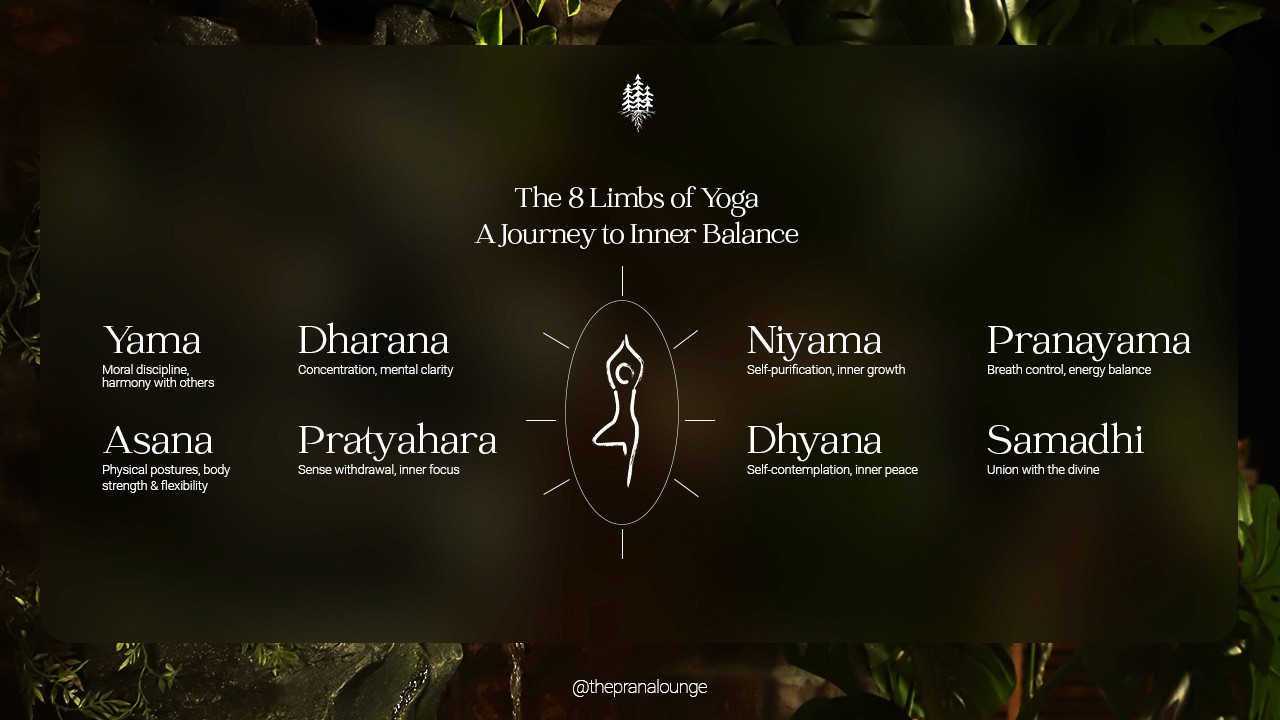
A Journey to Inner Balance, Through the Body and the Brain
Long before heart rate variability, nervous system mapping, or functional MRI scans, yoga offered a map of human regulation. Not a workout plan. Not a belief system. A framework for how attention, behavior, breath, and movement shape internal balance.
The Eight Limbs of Yoga, first outlined in the Yoga Sutras of Patanjali, are often misunderstood as philosophical ideals or spiritual steps. But viewed through a modern lens, they describe something deeply physiological: how humans move from reactivity toward regulation, from noise toward coherence.
Today, neuroscience and behavioral medicine are beginning to validate what this system quietly observed centuries ago.
Yama and Niyama: The Nervous System’s Social Context
Yama and Niyama are traditionally described as ethical principles and personal observances. In modern terms, they govern relational and internal stress load.
Research in psychoneuroimmunology shows that chronic interpersonal stress, unresolved guilt, or persistent internal conflict elevates sympathetic nervous system activity and inflammatory markers. Practices that foster honesty, restraint, self-compassion, and routine have been associated with lower cortisol levels and improved emotional regulation.
Simply put, how you live affects how your nervous system rests.
Studies in behavioral medicine confirm that consistent routines, reflective practices, and value-aligned behavior reduce stress reactivity and improve long-term mental health outcomes. These limbs create the psychological safety necessary for deeper physiological recovery.
Asana: Movement as a Signal of Safety
Asana is not about flexibility alone. It is about teaching the body that movement can occur without threat.
Slow, controlled postural practice improves proprioception, balance, and muscular coordination. More importantly, it reduces muscle guarding, a protective response driven by the brain when it perceives danger or instability.
Clinical studies show that mindful movement practices improve pain perception, reduce chronic musculoskeletal tension, and enhance parasympathetic activation. The benefit does not come from stretching harder. It comes from moving with awareness.
At Prana, this principle shows up as intentional sequencing, controlled transitions, and respect for nervous system pacing.
Pranayama: Breathing as Nervous System Regulation
Pranayama may be the most directly measurable limb in modern science.
Slow breathing techniques, particularly those emphasizing longer exhalations, stimulate the vagus nerve and shift the autonomic nervous system toward parasympathetic dominance. This results in lowered heart rate, improved heart rate variability, reduced blood pressure, and decreased stress hormone production.
Clinical trials have demonstrated that controlled breathing improves anxiety, sleep quality, emotional regulation, and even markers of inflammation. This is not symbolic. It is physiological.
Breath is one of the few voluntary behaviors that directly influences involuntary systems.
Pratyahara: Sensory Withdrawal and Cognitive Load
Pratyahara is often translated as turning inward. In modern terms, it is the deliberate reduction of sensory overload.
Constant stimulation keeps the brain in a heightened state of alert. Research shows that excessive sensory input increases cognitive fatigue, impairs focus, and sustains stress responses.
Practices that reduce sensory demand, such as dim lighting, quiet environments, and reduced visual clutter, allow the nervous system to recalibrate. This is why restorative spaces matter. Silence matters. Stillness matters.
Pratyahara is the bridge between external regulation and internal awareness.
Dharana and Dhyana: Attention as a Biological Skill
Dharana refers to focused attention. Dhyana describes sustained, effortless awareness. Together, they map onto what neuroscience calls attentional control.
Functional imaging studies show that meditation and focused attention practices strengthen prefrontal cortex function while reducing activity in the amygdala, the brain’s threat detection center. Over time, this leads to improved emotional regulation, reduced anxiety, and enhanced cognitive clarity.
Attention is not just mental. It is metabolic. Focused states consume less energy than scattered ones.
This is why mindfulness is increasingly prescribed as an adjunct therapy in stress-related conditions.
Samadhi: Coherence, Not Escape
Samadhi is often described as transcendence. From a physiological perspective, it reflects coherence.
Coherence occurs when brain waves, heart rhythms, breath, and muscular activity synchronize. Studies using EEG and heart coherence measures show that experienced meditators display highly efficient neural patterns, reduced stress reactivity, and increased emotional stability.
This state is not mystical. It is optimized regulation.
Samadhi is not about leaving the body. It is about inhabiting it fully, without resistance.
Why This Matters Now
Modern life keeps many people locked in sympathetic overdrive. Fast breath. Shallow sleep. Constant cognitive noise.
The Eight Limbs offer a counterbalance, not through force, but through sequencing. Ethics before exertion. Breath before stillness. Awareness before effort.
Science is now catching up to what this system quietly practiced: recovery is not passive. It is trained.
At Prana, these limbs are not taught as doctrine. They are embodied as experience. Through movement, breath, environment, and intentional pause, the body remembers how to regulate itself.
Balance is not something you chase.
It is something you create, one signal at a time.
✨ Ready to reset? Book your class today.