We often treat stress as a badge of honor, a necessary tax paid for living in the city, for building careers, or for simply "keeping up." But if we strip away the narrative and look strictly at the biology, stress is not a lifestyle choice. It is a chemical event.
When you feel that tightness in your chest or the shallow rhythm of your breath, it isn’t just "worry." It is your sympathetic nervous system hitting the panic button and flooding your bloodstream with cortisol and adrenaline. Your body thinks it is being hunted.
In the sanctuary of The Prana Lounge, we often speak of "calm" as a feeling. But today, lets look at this through the lens of a clinician. Calm is not just a mood. It is a measurable physiological state. And we can engineer it together.
The Biology of "The Pause"
Why does guided meditation work? It is not magic. It is mechanics.
When you sit for a guided session, whether it’s a quick 10-minute drop-in or a 60-minute Candlelight Yin, you are manually overriding your body’s default setting.
The HPA Axis Brake: Chronic stress keeps the Hypothalamic-Pituitary-Adrenal (HPA) axis permanently "on" and pumping cortisol. Meditation has been proven to lower serum cortisol levels, effectively telling your adrenal glands, "The tiger is gone. You can stand down."
The Amygdala Shrink: Neuroscientific studies using MRI scans have shown that consistent mindfulness practice can actually decrease the volume of the amygdala, the brain’s "fear center." You are literally reshaping your brain to be less reactive to stress, "The mind is like a muscle. It takes the shape of what you consistently hold in it."
Motion as Medicine: The Yoga & Pilates Connection
We tend to separate "working out" from "working in," but the body makes no such distinction. When you are in a Pilates class or holding a Warrior II, you are doing more than building muscle. You are toning your Vagus Nerve.
The Science of the Vagus Nerve:
This is the longest cranial nerve in the body, running from the brainstem to the gut. It is the superhighway of the Parasympathetic Nervous System, also known as the "Rest and Digest" mode.
Deep Breathing: The rhythmic, diaphragmatic breathing cues used in class stimulate the Vagus Nerve, instantly lowering heart rate and blood pressure.
GABA Production: Research indicates that a single hour of yoga can increase brain levels of GABA (gamma-aminobutyric acid) by up to 27%. GABA is the neurotransmitter that inhibits anxiety. Low GABA is linked to mood disorders, meaning yoga literally boosts your brain’s natural "chill pill."
The Ancient Clock: Ayurveda Meets Circadian Biology
In the West, we talk about "Circadian Rhythms," the 24-hour internal clock that regulates sleep and hormones. Thousands of years ago, Ayurveda called this Dinacharya (Daily Routine).
They are the same science, spoken in different tongues.
Ayurveda teaches that the day is divided into energies (Doshas). Aligning your rituals with these windows isn't just spiritual. It optimizes your metabolic biology.
1. The Morning Window (6:00 AM – 10:00 AM): Kapha
The Vibe: Heavy, slow, stable.
The Science: Body temperature is rising, and cortisol spikes to wake you up.
The Ritual: This is the time for Movement. A vigorous Vinyasa flow or Hot Pilates session here counteracts the natural heaviness (Kapha) of the morning and utilizes that cortisol spike for energy rather than anxiety.
2. The Midday Window (10:00 AM – 2:00 PM): Pitta
The Vibe: Fire, transformation, intensity.
The Science: Digestion is at its peak; metabolic fire is high.
The Ritual: Do the hardest work of the day now. Eat your largest meal. Your body is primed to process both food and information.
3. The Evening Window (6:00 PM – 10:00 PM): Kapha (Again)
The Vibe: Slowing down, grounding.
The Science: Melatonin production begins, and the body prepares for repair.
The Ritual: This is the time for Restorative Yoga or Candlelight Yin. High-intensity workouts here can spike cortisol and delay melatonin, ruining sleep. Instead, we use slow, ground-based postures to signal to the nervous system that the day is done.
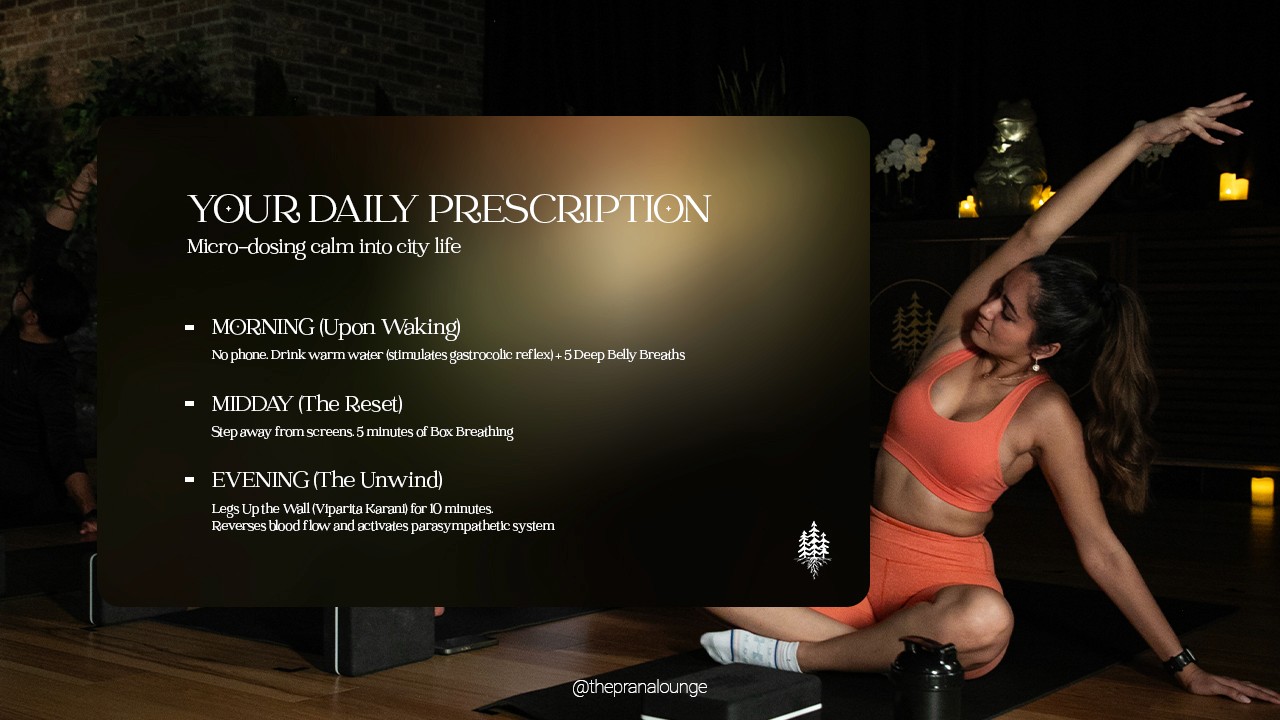
Your Daily Prescription
You do not need to move to a monastery to find peace. You simply need to introduce "micro-doses" of calm into your city life.
Try this 3-Step Ritual Tomorrow:
Morning (Upon Waking): Do not check your phone. Drink warm water (stimulates the gastrocolic reflex) and take 5 deep belly breaths.
Midday (The Reset): Step away from the screen. A 5-minute walk outside or a quick box-breathing session (Inhale 4, Hold 4, Exhale 4, Hold 4).
Evening (The Unwind): Legs Up the Wall (Viparita Karani) for 10 minutes. This reverses blood flow, drains fluid from the legs, and instantly activates the parasympathetic nervous system.
"Peace is not the absence of noise. It is the ability to find a quiet center within the noise."
See you on the mat.
✨ Ready to reset? Book your class today.