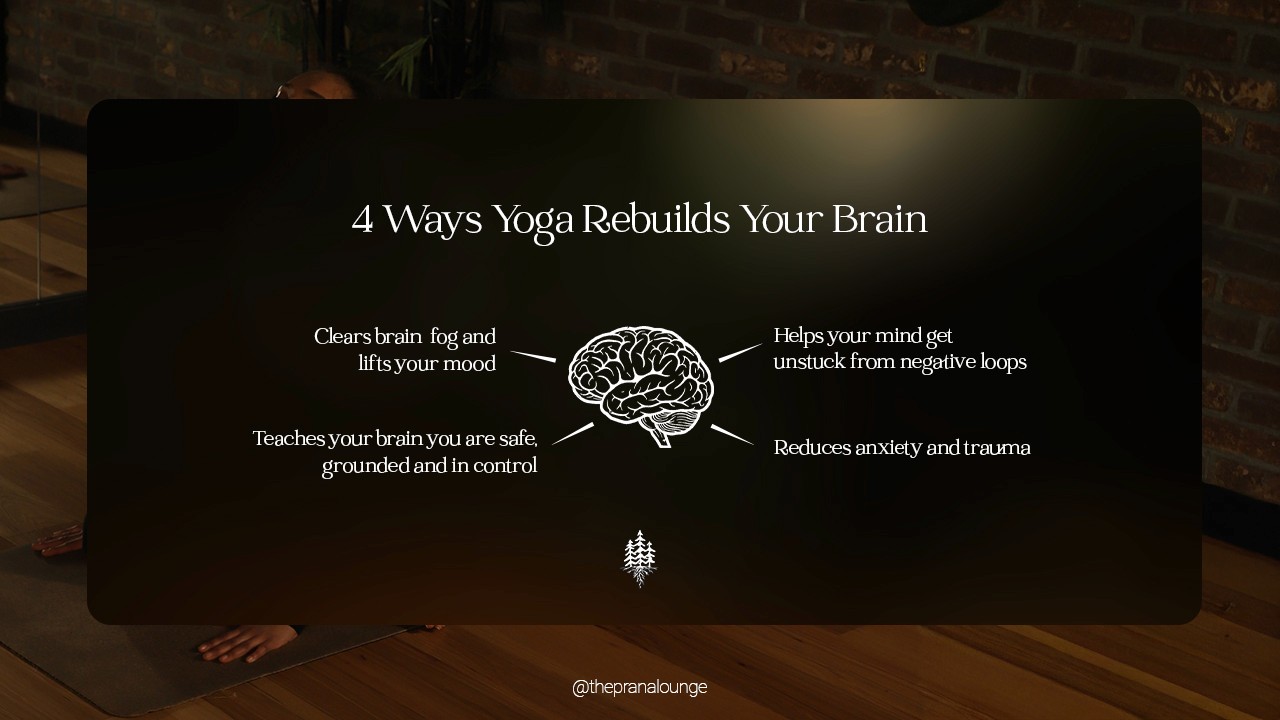
For decades, the medical community treated the head and the body as if they were neighbors that rarely spoke. If you had anxiety, you treated the mind. If you had muscle pain, you treated the body.
But we know that the mind and body are not just neighbors. They are the same house.
While the "Daily Calm" is about finding a pause in your day, understanding the mental health benefits of yoga requires us to go deeper. We need to look at how movement acts as a literal architect for your brain structure.
We are not just talking about "feeling good." We are talking about "rebuilding."
1. Neuroplasticity: The "Fertilizer" Effect (BDNF)
Depression and chronic high-stress states are often visible on an MRI. They can physically shrink the hippocampus, the part of the brain responsible for memory and emotional regulation. The brain becomes rigid, stuck in negative loops.
To break this, you need Neuroplasticity, the brain's ability to form new connections. The fuel for this process is a protein called BDNF (Brain-Derived Neurotrophic Factor). Think of BDNF as Miracle-Gro for your neurons.
Standard antidepressants (SSRIs) work partially by increasing BDNF. But yoga does this naturally.
A study published in Frontiers in Psychiatry demonstrated that a consistent yoga practice significantly increased serum BDNF levels.
When you flow through certain sequences, you are not just burning calories. You are flooding your brain with the molecular fuel it needs to grow new, healthier pathways out of depression.
2. The Inflammation Link: Cooling the System
One of the most groundbreaking discoveries in modern psychiatry is the link between inflammation and mental health. We now know that depression often looks like an allergic reaction. The body is fighting an invisible enemy, releasing inflammatory markers called Cytokines.
When your system is inflamed, your brain fog increases, your energy drops, and your mood plummets.
Yoga is a powerful anti-inflammatory agent. Research in Oxidative Medicine and Cellular Longevity found that 12 weeks of yoga significantly reduced levels of IL-6 and TNF-alpha, two primary markers of inflammation in the blood.
Infrared-heated studios amplify this benefit. The infrared heat penetrates the tissue to boost circulation, while the movement lowers the inflammatory response which physically cools down the heat of anxiety.
3. Interoception: Reconnecting the disconnect
Anxiety often manifests as a disconnect. We either feel too much (heart racing, panic) or we feel nothing (numbness, dissociation). This is a failure of Interoception, your ability to accurately sense what is happening inside your body.
When your internal GPS is broken, the world feels unsafe.
The part of the brain that handles this "inner sense" is the Insula. Studies show that yoga practitioners have greater cortical thickness in the insula and prefrontal cortex.
This means yoga serves as a recalibration tool. By focusing on where your foot lands in a lunge or how your ribcage expands in a breath, you are training your brain to interpret bodily signals accurately, rather than reacting to them as threats.
4. "Bottom-Up" vs. "Top-Down" Processing
This is perhaps the most critical distinction in mental health.
Top-Down Processing: This is talk therapy. You use your "thinking brain" (Prefrontal Cortex) to try and talk your "emotional brain" (Limbic System) out of a panic attack. It is effective, but it is slow.
Bottom-Up Processing: This is Yoga. You use the body to send a signal up the Vagus nerve to the brain stem, forcing a state change.
You cannot always "think" your way out of anxiety. Sometimes, the cognitive brain is offline. In those moments, you must "move" your way out. As noted in Frontiers in Human Neuroscience, somatic (body-based) interventions can access trauma stored in the nervous system that language simply cannot reach.
"The body is the shortcut. It bypasses the stories we tell ourselves and goes straight to the source."
Your New Baseline
When you view yoga through this lens, it stops being a "workout" or a "hobby." It becomes mental hygiene. It becomes a non-negotiable prescription for resilience.
You are not just stretching hamstrings. You are increasing BDNF. You are lowering Cytokines. You are thickening your Insular Cortex.
You are building a stronger vessel.
✨ Ready to reset? Book your class today.