There is a persistent myth that stops most people before they ever step onto a mat. It is the whisper that says, "I can’t do yoga. I’m not flexible enough."
Simply put, this is like saying, "I can’t take a shower. I’m too dirty."
You do not practice yoga because you are flexible. You practice yoga to become functional. Do not see yoga as a performance, but as a maintenance protocol for the human machine. The body you have today is not the body you are stuck with. It is simply the body you have built so far.
If you are ready to change the schematic, here is the science of how regular practice rewrites your biology, from your fascia to your DNA.
1. The Fascia Fix: Why You Feel "Stiff"
When you feel stiff in the morning, it is rarely just your muscles that are tight. It is your Fascia.
Fascia is the connective tissue that wraps around every muscle, bone, and organ like a biological wetsuit. When we are sedentary, fascia becomes dehydrated and sticky, gluing your layers of tissue together. This is why you feel "locked up."
Research in the field of mechanobiology shows that slow, held stretches (like in Candlelight Yin or Hot Prana classes) stimulate fibroblasts to produce fresh collagen and hyaluronic acid.
Hyaluronic Acid: This is the body's natural lubricant.
The Result: Yoga literally re-hydrates your internal tissues, allowing muscles to slide over each other smoothly again. You are not just "stretching." You are ungluing.
"Motion is lotion. We are greasing the gears."
2. The Anti-Aging Effect: Lengthening Your Telomeres
We often judge "aging" by wrinkles or grey hair, but true aging happens at the cellular level. At the end of your chromosomes, there are protective caps called Telomeres. Every time your cells divide, these caps get shorter. When they get too short, the cell dies.
Stress and inflammation speed up this shrinking process. Yoga slows it down.
A landmark study published in Oxidative Medicine and Cellular Longevity found that 12 weeks of yoga and meditation significantly reduced the rate of cellular aging. Even more impressive, studies have shown that regular practice increases the activity of Telomerase, the enzyme that repairs these caps.
By getting on the mat, you are effectively hacking your biological clock.
3. The Cardiovascular Reset: More Than Just "Zen"
Many beginners assume that because they aren't gasping for air, they aren't improving their heart health. This is a misunderstanding of how the cardiovascular system works.
Yoga improves Baroreflex Sensitivity. This is your body's ability to regulate blood pressure quickly.
A systematic review in the European Journal of Preventive Cardiology compared yoga to conventional exercise. The results were startling. Yoga provided similar improvements in lipid profiles (cholesterol) and blood pressure as brisk walking or cycling.
Why? Because yoga reduces the sympathetic tone (stress) that clamps down on blood vessels. When the vessels relax, the heart doesn't have to work as hard.
4. Actionable Tips for the Beginner
Knowing science is the motivation. But the practice is where the change happens. If you are new to the ecosystem, here is your roadmap for the first month.
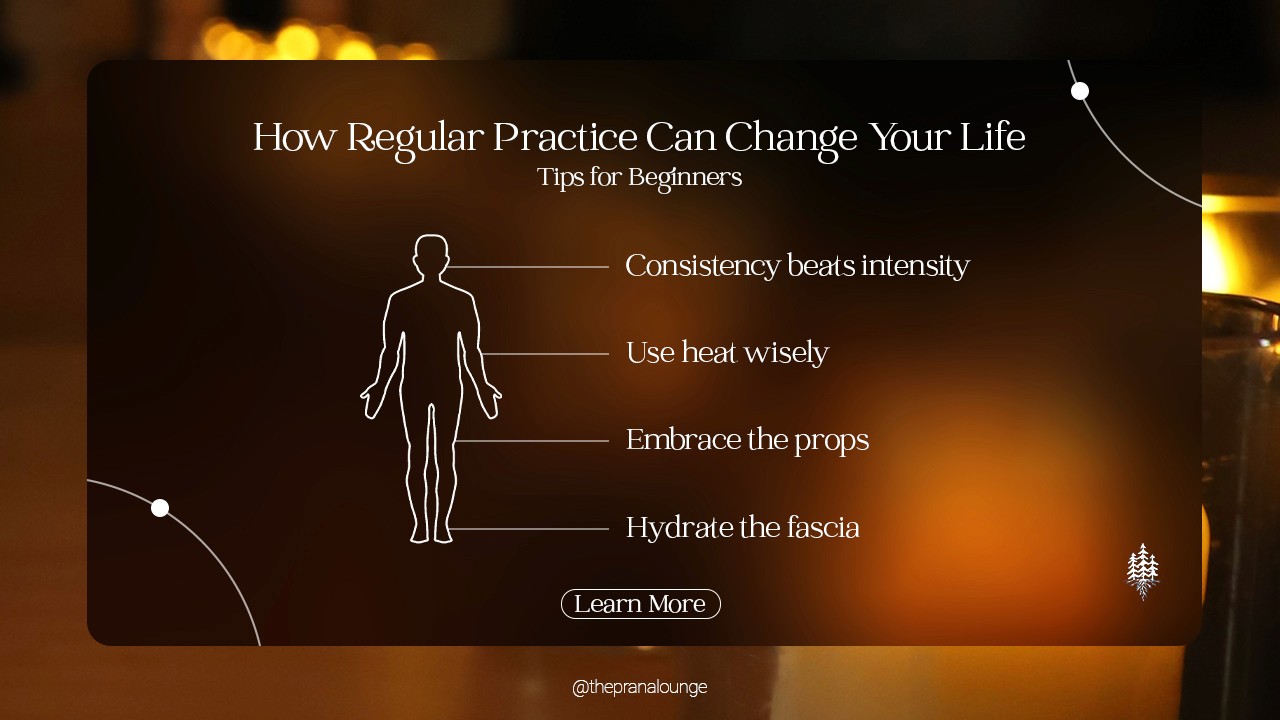
Tip 1: Consistency Beats Intensity
You do not need to do a 90-minute advanced class to see changes.
The Trick: Commit to the "2-Day Rule." Never let more than two days pass without getting on your mat, even if it is just for 20 minutes. Frequency signals safety to the nervous system, allowing it to release tension faster.
Tip 2: Use the Heat (Wisely)
Infrared Heat is a tool, not just a challenge.
The Trick: If you have chronic stiffness, start with a heated class. The infrared waves penetrate the skin to warm the muscles before you stretch, increasing tissue elasticity and reducing the risk of injury. It is a shortcut to flexibility.
Tip 3: Embrace the Props
Blocks and straps are not "training wheels." They are skeletal extenders.
The Trick: If you cannot touch your toes, bring the floor closer to you with a block. This maintains the integrity of your spine. A straight spine with a block is infinitely better for your health than a curved spine reaching for the floor.
Tip 4: Hydrate the Fascia
Since yoga releases hydration into the tissues, you need to put water into the system first.
The Trick: Drink a glass of water with a pinch of sea salt 30 minutes before class. This helps with electrolyte balance and ensures your fascia has the fluid it needs to become pliable.
You might come to the studio to touch your toes. But you will stay because of how it feels to live in a body that functions without pain.
The "stiffness" you feel is not permanent. The "aging" you fear is not entirely out of your control. Your body is incredibly forgiving. It is just waiting for the right inputs.
Come join us. Let’s see what we can build together.
✨ Ready to reset? Book your class today.