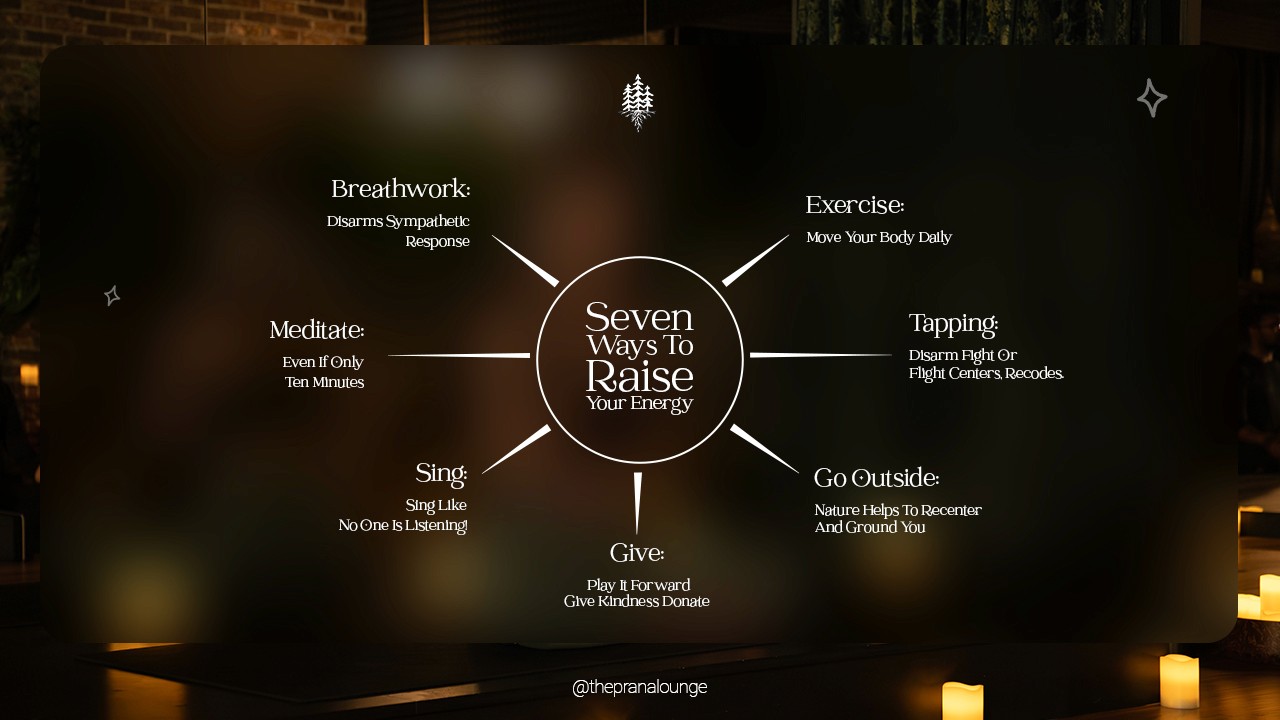
When people say they want more energy, they usually mean more fuel.
More coffee. More motivation. More discipline.
But biology tells a different story.
Energy is not something you force. It is something you allow when your nervous system feels safe, regulated, and supported.
Modern science now confirms what ancient practices have always hinted at: sustainable energy does not come from stimulation. It comes from balance.
Here is what each pathway is really doing inside your body.
1. Breathwork: Disarming the Stress Response
Breath is the fastest way to communicate with the nervous system. Slow, controlled breathing activates the parasympathetic branch, often referred to as the “rest and digest” system.
Multiple studies published in Frontiers in Psychology and Frontiers in Human Neuroscience show that slow breathing increases vagal tone, reduces heart rate, lowers cortisol levels, and improves emotional regulation. When the sympathetic stress response is disarmed, energy that was being spent on vigilance becomes available for focus, repair, and clarity.
This is why breathwork often feels energizing even though the body is doing less. You are no longer wasting energy on unnecessary alertness.
2. Meditation: Even Ten Minutes Is Enough
Meditation is not about emptying the mind. It is about changing how the brain allocates resources.
Neuroimaging studies from Harvard Medical School show that even short daily meditation practices reduce activity in the default mode network, the part of the brain associated with rumination and mental fatigue. At the same time, areas linked to attention and emotional regulation become more efficient.
Efficiency is energy.
Ten minutes of meditation reduces cognitive load. Less internal noise means more usable mental energy throughout the day.
3. Singing: Activating the Vagus Nerve
Singing may feel playful, but physiologically it is powerful.
Research published in Psychology of Music and Frontiers in Neuroscience shows that vocalization stimulates the vagus nerve, improves heart rate variability, and synchronizes breathing patterns. Group singing has even been shown to lower stress hormones and improve mood regulation.
From a biological perspective, singing tells the nervous system that the environment is safe. You do not sing when you are under threat. That signal alone shifts the body out of stress mode and frees up energy for immune function and emotional resilience.
No audience required.
4. Exercise: Moving the Body Daily
Movement raises energy not by exhausting the body, but by improving circulation, mitochondrial efficiency, and insulin sensitivity.
Studies in The Journal of Physiology and Sports Medicine confirm that regular moderate movement improves oxygen delivery, reduces inflammatory markers, and enhances metabolic flexibility. When cells become more efficient at producing energy, fatigue decreases.
Importantly, this does not require high intensity workouts. Gentle, consistent movement is enough to tell the body it is alive, capable, and safe to generate energy again.
5. Tapping: Calming the Fight or Flight Centers
Tapping, often referred to as Emotional Freedom Techniques (EFT), combines light touch with focused attention.
A growing body of research, including randomized controlled trials published in The Journal of Nervous and Mental Disease, shows that tapping reduces cortisol levels and amygdala activation. The amygdala is the brain’s threat detector. When it quiets down, energy previously used for hypervigilance becomes available for cognition and emotional balance.
This is not a placebo. It is nervous system downregulation through sensory input.
6. Going Outside: Nature as a Regulator
Nature exposure has measurable physiological effects.
Research in Environmental Health and Preventive Medicine shows that spending time outdoors lowers cortisol, reduces blood pressure, and improves parasympathetic activity. Even short periods in natural environments improve mood and reduce mental fatigue.
The nervous system evolved in nature. Urban environments demand constant processing. Stepping outside reduces sensory overload and allows the brain to rest, restoring energy without effort.
7. Giving: The Biology of Kindness
Acts of giving and kindness activate reward pathways in the brain.
Studies from the National Institutes of Health show that generosity increases dopamine and oxytocin release, hormones associated with pleasure, connection, and reduced stress. These hormonal shifts improve immune function and reduce inflammation.
Giving does not drain energy. It creates it by aligning social connection with biological reward systems.
Energy Is a Nervous System State
What these seven practices have in common is not motivation. It is regulation.
Energy rises when the nervous system feels safe enough to stop guarding. When stress responses are quiet, digestion improves. Immune function strengthens. Sleep deepens. Focus returns.
At Prana, this understanding shapes every practice. Breath, movement, stillness, sound, warmth, and community are not separate wellness tools. They are coordinated signals telling your body it can exhale.
You do not need to become more disciplined.
You need to become more regulated.
That is how energy returns.
✨ Ready to reset? Book your class today.
📍 658 Homer Street (Vancouver)