For most of our lives, we are told a simple story about flexibility:
Tight muscles need stretching. Stiffness means you are not flexible enough. Mobility is about pushing your body further.
But modern neuroscience tells a different truth. Mobility is not a battle between you and your muscles. It is a negotiation with your nervous system.
In other words, the limit you feel in a forward fold or a twist is not your hamstrings being short or your hips being “bad.” It is your brain protecting you.
And when you understand that, everything about movement changes.
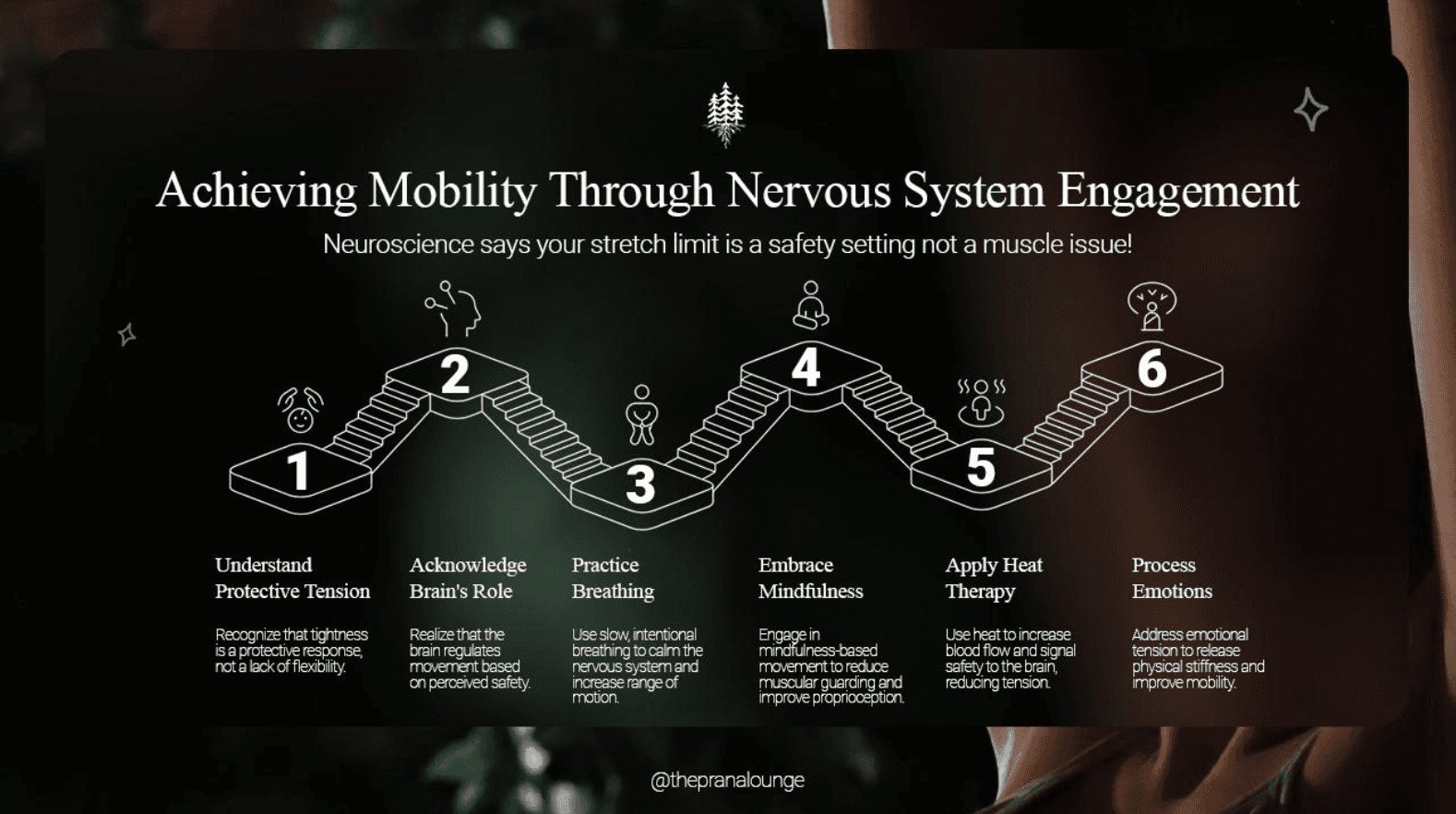
1. Tightness is protective tension, not lack of flexibility
Most people think they are tight because their muscles are physically stiff.
But several studies show that flexibility is not primarily a structural property of the muscle. It is a sensory and neurological one.
In a landmark study published in the Journal of Physiology, researchers found that after weeks of stretching, participants became “more flexible” not because their muscles lengthened significantly, but because their nervous system became more tolerant to the sensation of stretching.
This means your body was physically capable all along. The nervous system simply said “this is far enough, thank you” and created tension to keep you safe.
This protective tension shows up when:
you sit too much
you are stressed
you are sleep deprived
you are rushing through your day
you breathe shallowly
you brace without noticing
Your body is not inflexible. It is guarded.
2. The brain decides how far you can move
Mobility is regulated by the sensory feedback loops between:
muscle spindles
Golgi tendon organs
the spinal cord
the motor cortex
and the limbic system (yes, your emotional brain)
These systems work together to determine your “safe range.”
If your brain perceives a stretch as threatening, it will lock the area down.
Not because you are doing something wrong, but because that is its evolutionary job.
Your nervous system’s priority is survival, not a deeper pigeon pose.
3. Breathing is the fastest way to negotiate with your nervous system
This is where science gets beautiful.
Slow, intentional breathing activates the parasympathetic nervous system. Research in the Frontiers in Human Neuroscience journal shows that even a few minutes of relaxed breathing:
reduces stretch reflex sensitivity
decreases muscle spindle firing
lowers perceived threat
increases range of motion
Translation?
If you breathe better, you move better.
This is why in yoga and dynamic stretching, the moment your breath starts shaking, the body tightens.
But when your breathing slows, your nervous system says “okay, I trust this” and opens your range.
Mobility is permission, not force.
4. Mindfulness improves mobility more than brute-force stretching
Trying to force flexibility creates resistance.
This is why people who aggressively stretch often feel tighter over time.
Mindfulness based movement changes the game because it:
calms the limbic system
reduces muscular guarding
improves proprioception
increases confidence in movement
A study from the International Journal of Yoga showed that yoga practitioners improved flexibility significantly more than static stretching groups, even with less intensity.
Not because the muscles were stretched more, but because the nervous system experienced a safer environment.
Your mind relaxes the body.
5. Warm-up, heat, and slow progression work because they soothe the nervous system
Heat therapy is not magic. It is biology.
Heat increases blood flow, decreases nociceptor sensitivity, and signals to the brain that the environment is safe.
This reduces the protective tension response and allows deeper mobility with less resistance.
This is why:
hot yoga feels easier
slow warm-ups feel more natural
mobility sessions improve after a warm shower
gentle dynamic movement feels more accessible than static pulling
You are not manipulating your muscles.
You are soothing your system.
6. Emotional tension becomes physical stiffness
What you cannot release emotionally, your body will often store physically.
Research in somatic psychology and neuroscience shows strong connections between:
chronic stress
emotional suppression
trauma responses
autonomic dysregulation
These patterns often appear in:
locked hip flexors
clenched jaws
tight necks and shoulders
guarded lower backs
This is not symbolic.
It is a direct nervous system pattern.
When emotions are held, the body holds.
When emotions are processed, the body softens.
The truth that changes everything
You are not “bad at flexibility.”
You are not “too stiff.”
You are not behind.
Your nervous system is simply doing its job.
And when you treat mobility as a conversation instead of a fight, your body responds with trust.
Slow movement.
Calm breath.
Consistent practice.
A safe internal environment.
This is how mobility opens from the inside out.
This is how flexibility becomes freedom.
✨ Ready to reset? Book your class today.