Most people think stress feels like panic, overwhelm, or emotional collapse.
But the truth is quieter.
The real danger is not the dramatic moments.
It is the constant background hum that becomes so normal you can’t feel it anymore.
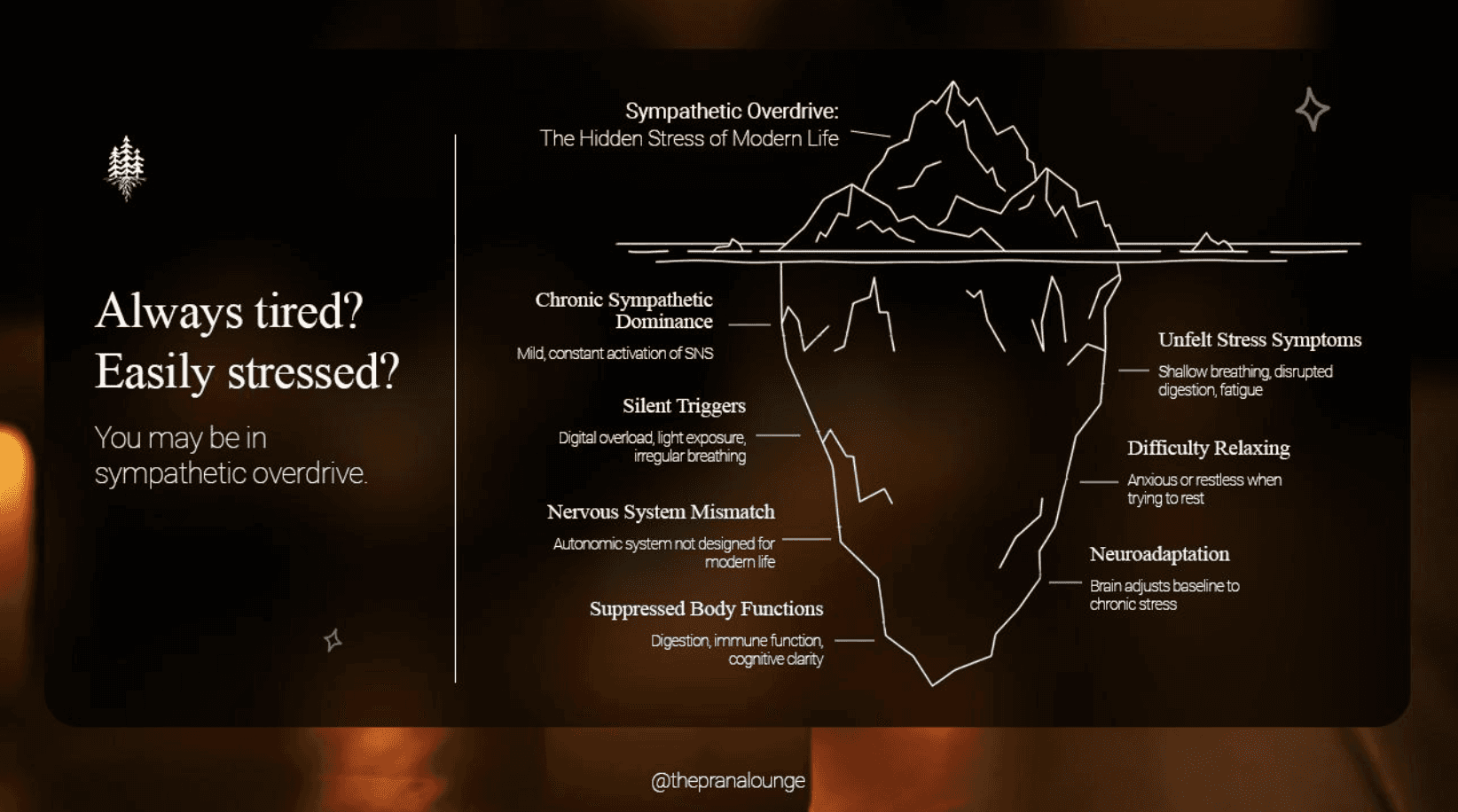
Modern life has pushed the human body into a near-permanent state of mild activation, something scientists call chronic sympathetic dominance. It is subtle, steady, and deceptively silent. And because it does not feel like a crisis, most people never realize their nervous system is stuck in “survival mode.”
To understand why this happens, we begin with the basics.
The Nervous System Was Never Designed for Modern Life
Your autonomic nervous system has two main branches:
Sympathetic nervous system (SNS): alert, focused, mobilized
Parasympathetic nervous system (PNS): calm, rest, digestion, repair
Evolution built the SNS for short bursts of survival: escaping danger, protecting yourself, reacting quickly.
But in the last 100 years, the human environment changed faster than biology could keep up.
Studies published in Nature, Frontiers in Neuroscience, and the American Psychological Association all show the same pattern: chronic stressors (noise, notifications, deadlines, financial uncertainty, city living, sleep disruption) activate the SNS in small bursts all day long.
Even when the “threat” is not life-or-death, the brain treats it like one.
Stress You Don’t Feel Is Still Stress
The most misleading part of sympathetic overdrive is that you can look calm on the outside and still be running high internally.
Research from the Cleveland Clinic, Stanford Medicine, and Harvard Health shows that chronic sympathetic activation often presents as:
Shallow breathing
Disrupted digestion
Light sleep
Irregular hunger patterns
Fatigue that caffeine temporarily masks
A “wired but tired” feeling at night
Difficulty relaxing without external stimulation
None of these feel like “classic stress,” which is why people miss the signs.
Why You Stop Noticing: Adaptation, Not Recovery
When stress becomes chronic, the brain adjusts.
This is called neuroadaptation — the process in which your baseline shifts to match your environment.
Instead of calming down, your “normal” becomes:
Higher heart rate
Higher inflammation
Lower heart rate variability (HRV)
Increased cortisol output
Poor vagal tone
A 2022 review in Frontiers in Psychology found that the majority of adults living in urban environments show reduced parasympathetic activity and do not recognize it because the body adapts to keep functioning.
This is why people say things like:
“I don’t feel stressed, I’m just tired.”
“I can’t relax unless I’m watching something.”
“My mind is always busy, but that’s just how I am.”
These are not personality traits.
These are symptoms of sympathetic overdrive.
The Silent Triggers Most People Ignore
1. Digital overload
Notifications increase SNS activity even when ignored.
(University of Texas, 2017)
2. Constant light exposure at night
Blue light suppresses melatonin, increasing sympathetic activation.
(University of Pennsylvania, 2019)
3. Irregular breathing
Most adults breathe shallowly from the upper chest. This signals the brain that danger is near.
(Stanford School of Medicine, 2020)
4. Sedentary work
Long periods of sitting reduce parasympathetic tone.
(Columbia University Medical Center, 2023)
5. Noise
Urban sound levels elevate cortisol throughout the day.
(WHO Environmental Noise Guidelines, 2018)
None of these feel like emergencies, which is exactly why they are dangerous.
How Sympathetic Overdrive Affects the Body
Chronic sympathetic activation suppresses:
Digestion
Immune function
Reproductive hormones
Cognitive clarity
Emotional resilience
Deep sleep cycles
The body cannot repair itself if it cannot shift into parasympathetic mode.
This is why so many people live in a loop of:
Stress → Exhaustion → Stimulation → Stress again
A 2021 study in JAMA Psychiatry found that sympathetic overactivation is strongly linked with:
Anxiety disorders
Digestive disorders
Cardiovascular disease
Chronic fatigue
Insomnia
Burnout
Not because people make bad choices but because their physiology is stuck in “go mode.”
Why You Only Feel It When You Stop
One of the clearest symptoms of sympathetic dominance is that people feel anxious or restless when they try to rest.
The brain interprets stillness as unfamiliar.
The body has forgotten how to shift gears.
So the moment you slow down, your system feels unsafe.
This is why yoga, pilates, breathwork, and slow movement are not just “wellness activities.”
They are nervous system retraining practices.
How The Prana Lounge Helps Break the Cycle
Inside the studio, everything is designed to pull you back into parasympathetic territory:
Heat increases microcirculation and muscle relaxation
Breath-led movement activates vagal tone
Slow transitions regulate heart rate
Mindfulness restores interoception
Consistent practice rewires the stress baseline
A 2020 meta-analysis in PLoS One shows that breath-led yoga practices significantly reduce sympathetic activity and increase HRV within minutes.
This is why people leave class saying they “feel like themselves again.”
They are not imagining it.
Their biology shifted.
The Real Question
Most people are not choosing stress.
They are simply living in a world that keeps their nervous system switched on.
The choice lies in whether you want to stay there.
Because calm is not passive.
It is something you train, choose, and return to.
One breath at a time.
One class at a time.
One nervous system reset at a time.
✨ Ready to reset? Book your class today.
📍 658 Homer Street (Vancouver)