There are days when your mind feels crowded.
Too many thoughts. Too many tabs open.
Even when you sit still, nothing really slows down.
This is where breathwork becomes useful. Not as a concept, but as something you can actually do in the moment.
Alternate nostril breathing is one of those practices.
Simple enough to learn in a few minutes. Subtle enough that you might underestimate it.
But it works quietly on the systems that matter.
What Is Alternate Nostril Breathing?
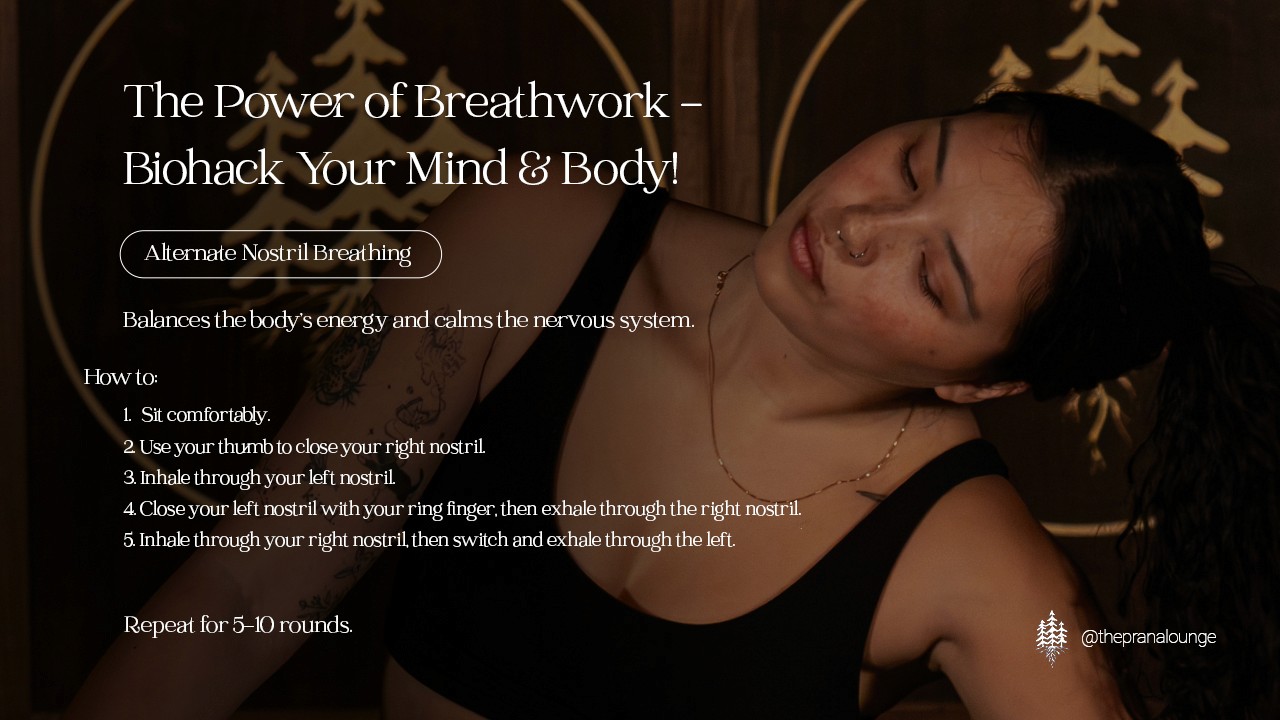
Also known as Nadi Shodhana in traditional yoga, this technique involves breathing through one nostril at a time in a steady rhythm.
It is not about taking bigger breaths.
It is about creating balance.
You guide the breath. The body follows.
What Happens in the Body When You Practice It
Breathing is one of the few things that is both automatic and controllable.
When you slow it down intentionally, it begins to influence the nervous system.
Research published in the International Journal of Yoga shows that alternate nostril breathing can improve autonomic balance, meaning it helps regulate the shift between stress and relaxation responses.
Another study in Frontiers in Human Neuroscience highlights how controlled breathing practices reduce activity in stress-related pathways and improve emotional regulation.
What this means in simple terms:
Heart rate begins to slow
Blood pressure can stabilize
Mental agitation starts to settle
Focus improves
It is not instant magic. But it is noticeable.
Why It Feels Calming
When you are stressed, your breathing becomes uneven and shallow.
Alternate nostril breathing introduces structure.
That structure gives your brain something predictable to follow.
Over time, this signals safety.
And when the body feels safe, it stops bracing.
How to Practice Alternate Nostril Breathing
You do not need a perfect setup.
Just sit comfortably. Keep your spine relaxed but upright.
Step-by-step
Sit in a comfortable position
Use your thumb to gently close your right nostril
Inhale slowly through your left nostril
Close your left nostril with your ring finger
Release your right nostril and exhale through it
Inhale through your right nostril
Close it, then exhale through the left
That completes one round.
Repeat for 5 to 10 rounds.
Small Adjustments That Make a Big Difference
This is where most people either rush or overcomplicate things.
Keep it simple.
Focus on these instead:
Keep your breath steady
Not forced. Not exaggeratedSit comfortably
If your body is tense, your breath will be tooGo slow
Faster is not better hereClose your eyes if it helps
Reduces distraction and improves awareness
When to Use This Practice
You do not need a specific reason.
But it helps most when your system feels slightly off.
Good times to try it:
Before starting your day
During a stressful moment
Before sleep
After long screen time
Even a few minutes can shift how you feel.
What People Usually Get Wrong
They expect immediate transformation.
Or they treat it like a performance.
This is not something you “do well” or “do poorly.”
It is something you return to.
Some days your breath will feel smooth.
Other days it will feel uneven.
That is fine.
The benefit comes from repetition, not perfection.
The Subtle Benefits Over Time
If you keep coming back to this practice, small changes begin to show up.
You react less quickly to stress
Your breathing naturally slows during the day
You feel less mentally scattered
You recover faster after stressful moments
These are not dramatic changes.
But they are real.
A Practical Way to Think About It
You do not need an hour.
You need a few minutes where nothing else is competing for your attention.
No phone. No multitasking.
Just breathe.
That alone can reset more than you expect.